Wikipedia article
Viburnums
Viburnum is a genus of about 150–175 species of flowering plants in the family Viburnaceae. Its current classification is based on molecular phylogeny. It was previously included in the family Caprifoliaceae. The member species are evergreen or deciduous shrubs or (in a few cases) small trees native throughout the temperate Northern Hemisphere, with a few species extending into tropical montane regions in South America and southeast Asia. In Africa, the genus is confined to the Atlas Mountains.
Name
The generic name Viburnum originated in Latin, in which it referred to V. lantana.
Description
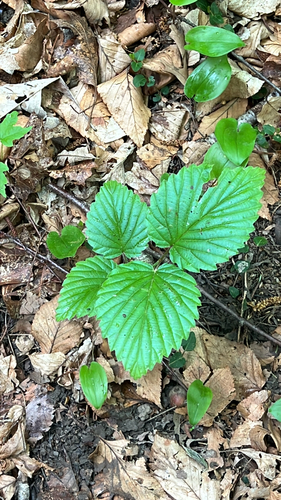
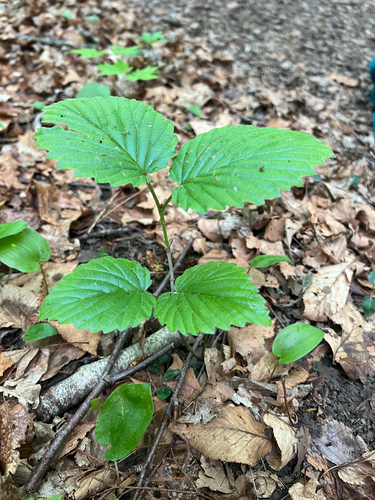
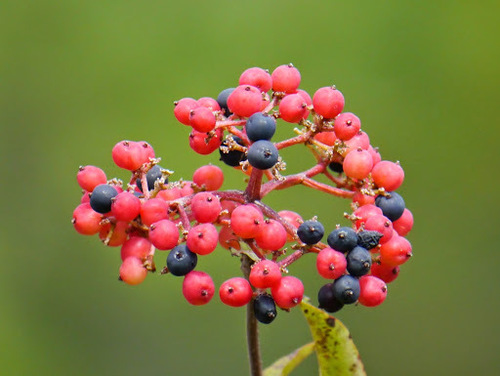
The leaves are opposite, simple, and entire, with toothed or lobed margins. Cool temperate species are deciduous, while most of the warm temperate species are evergreen. Some species have densely hairy shoots and leaves covered in star-shaped hairs. Almost all species have stipules on petioles, except tropical species found in Malesia. The flowers are produced in corymbs 5–15 cm (2.0–5.9 in) across. Each flower is white, cream or pink, small (3–5 mm across), and has five petals. Some species are strongly fragrant. The gynoecium has three connate carpels with the nectary located at the top of the gynoecium. Some species also have a fringe of large, showy sterile flowers around the perimeter of the corymb, serving as a pollinator target. The fruit is a spherical, oval, or somewhat flattened drupe that is red, purple, blue, or black, and contains a single seed. Some fruits are edible, but many others are mildly poisonous. The leaves are eaten by the larvae of many lepidopteran species.
Species
Around 165 species are described. A 2014 phylogenetic study proposed the following phylogenetic scheme and sections:
Formerly placed here
Hydrangea arborescens L. (as V. alnifolium Marshall, or V. americanum Mill.) Hydrangea macrophylla (Thunb.) Ser. (as V. macrophyllum Thunb.)
Cultivation and uses
Many species of viburnum have become popular as garden or landscape plants because of their showy flowers and berries, fragrance, and good autumn colour of some forms. Some popular species, hybrids, and cultivars include: The hybrid Viburnum × bodnantense (V. farreri × V. grandiflorum) is particularly popular for its strongly scented pink flowers on the leafless deciduous shoots in mid- to late winter. Viburnum × burkwoodii (V. carlesii × V. utile) Viburnum × carlcephalum (V. carlesii × V. macrocephalum) Viburnum carlesii has round white flowerheads, strong fragrance, dense structure, and reddish leaves in autumn. Viburnum davidii is an evergreen species from China with blue fruit. Viburnum dentatum has flat-topped flowers, bluish fruit, and reddish leaves in autumn. It is somewhat salt-tolerant. The cultivar 'Blue Muffin' is more compact than the species and has fruit that is a deeper blue than the species. Viburnum dilatatum has flat-topped flowers, reddish leaves in autumn, and bright red fruit that persist into winter. Viburnum × jackii – Jack's viburnum Viburnum × juddii (V. bitchiuense × V. carlesii) Viburnum plicatum has white flowers, textured leaves, reddish-black fruit, and can grow quite large under ideal conditions. The species can tolerate shade, but not drought. Viburnum × pragense (V. rhytidophyllum × V. utile) Viburnum × rhytidophylloides (V. lantana × V. rhytidophyllum)popular evergreen shrub, drought resistant. Shiny green leaves, white flowers. Viburnum rhytidophyllum is a popular evergreen species, grown mainly for its foliage effect of large, dark green, leathery leaves with a strongly wrinkled surface. This is the parent species of two popular hybrid cultivars known as 'Alleghany' and 'Pragense'. 'Alleghany' was selected from a hybrid between V. rhytidophyllum and V. lantana 'Mohican' (in 1958, at the US National Arboretum). Viburnum setigerum has upright, coarse structure and orange to reddish-orange fruit. Viburnum sieboldii has a coarse, open structure, flat-topped flowers, reddish-black fruit, and can grow as a small tree. Viburnum tinus is a widely grown garden and landscape shrub. The cultivars 'Pragense' and 'Eskimo', of mixed or uncertain parentage, have won the Royal Horticultural Society's Award of Garden Merit.
Other uses
In prehistory, the long, straight shoots of some viburnums were used for arrow-shafts, as those found with Ötzi the Iceman. The fruit of some species (e.g., V. lentago) is edible and can be eaten either raw or for making jam. In contrast, other species (e.g., V. opulus) are mildly toxic and can cause vomiting if eaten in quantity. The bark of some species is used in herbal medicine, as an antispasmodic and to treat asthma.
Cultural references
In Ukraine, Viburnum opulus is an essential element of traditional folk culture, and Viburnum opulus (kalyna) is seen as a national symbol and emblem for both the Koliada festivities, as well as representing young girls' love and tenderness. It is a key element of Ukrainian traditional wreaths. Many folk songs are dedicated to the kalyna, as well as a very popular song "Oi u Luzi Chervona Kalina". The Lithuanian name for the genus Viburnum is "Putinas". This was the pen name of Lithuanian poet and writer Vincas Mykolaitis. In 2000, the Lithuanian liquor company Alita released a vodka named Putin Vodka, with a red, white, and blue label, which are the colours of the Russian flag. Sold only in Lithuania at that time, a company spokesperson said that the name had its origin in the tree "putinas", after speculation arose that it was named after Russian president Vladimir Putin.