Glossary
A glossary of biological terms that includes all definitions from books and notes, along with additional terms for comprehensive coverage.
Press
- agaricomycete
- /ˌæɡəˌraɪkəˈmaɪsiːtiːz/
- A class of fungi that includes the mushrooms, toadstools, puffballs, and shelf fungi.
Wikitionary definitions:
- Any fungus of the class Agaricomycetes
- ·
- ascomycete
- /ˌæskəˈmaɪsiːt/
- A fungus that produces its spores in a sac-like structure called an ascus.
Wikitionary definitions:
- Any fungus of the phylum Ascomycota, characterized by the production of a sac, or ascus, which contains non-motile spores.
- ·
- asexual reproduction
- /ˈeɪsɛksjʊəl ˌriːprəˈdʌkʃ(ə)n/
- Reproduction not involving the union of gametes.
Wikitionary definitions:
- Any form of reproduction that does not involve the fusion of gametes.
- Any form of reproduction that involves neither meiosis nor fusion of gametes.
- ·

- autotroph
- /ˈɔːtəʊtrəʊf/
- An organism that is able to form nutritional organic substances from simple inorganic substances such as carbon dioxide.
Wikitionary definitions:
- Any organism that can synthesize its food from inorganic substances, using heat or light as a source of energy.
- ·

- basidiomycete
- /ˌbæsɪdɪəʊmaɪˈkəʊtə/
- A fungus that produces its spores on a basidium.
Wikitionary definitions:
- Any fungus of the phylum Basidiomycota, that produces sexual spores on a basidium.
- ·
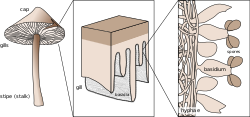
- basidium
- /bəˈsɪdɪəm/
- A microscopic, club-shaped spore-bearing structure produced by basidiomycetes.
Wikitionary definitions:
- A small structure, shaped like a club, found in the Basidiomycota division of fungi, that bears four spores at the tips of small projections.
- ·
- catalysis
- /ˈkat(ə)lɪst/
- The acceleration of a chemical reaction by a catalyst.
Wikitionary definitions:
- The increase of the rate of a chemical reaction, induced by a catalyst.
- ·

- coenocytic
- /ˌsiːnəˈsɪtɪk/
- Consisting of a multinucleate mass of cytoplasm not divided into cells.
Wikitionary definitions:
- Relating to coenocytes or to coenocysts
- ·
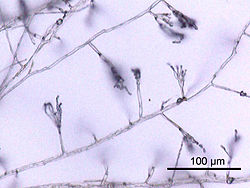
- conidiophore
- /kəˈnɪdɪəʊfɔː/
- A specialized fungal structure that produces conidia.
Wikitionary definitions:
- A fungal hypha that produces conidia.
- ·
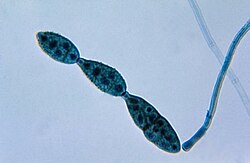
- conidium
- /kəˈnɪdɪəm/
- A non-motile asexual spore that forms a chain at the tip of a conidiophore.
Wikitionary definitions:
- A fungal spore produced asexually in a conidiophore.
- ·
- cytoplasm
- /ˈsaɪtəˌplæzəm/
- The material or protoplasm within a living cell, excluding the nucleus.
Wikitionary definitions:
- The contents of a cell except for the nucleus. It includes cytosol, organelles, vesicles, and the cytoskeleton.
- ·

- deciduous
- /dɪˈsɪdʒuəs/
- (of a tree or shrub) shedding its leaves annually.
Wikitionary definitions:
- Describing a part that falls off, or is shed, at a particular time or stage of development.
- Of or pertaining to trees which lose their leaves in winter or the dry season.
- Transitory, ephemeral, not lasting.
- ·

- diploid
- /ˈdɪplɔɪd/
- (of a cell or nucleus) containing two complete sets of chromosomes, one from each parent.
Wikitionary definitions:
- Of a cell, having a pair of each type of chromosome, one of the pair being derived from the ovum and the other from the spermatozoon. Most somatic cells of higher organisms are diploid.
- Of an organism, having diploid cells.
- Of a certain symmetry class with 24 congruent irregular quadrilateral faces.
- ·
- enzyme
- /ˈɛnzaɪm/
- A substance produced by a living organism that acts as a catalyst to bring about a specific biochemical reaction.
Wikitionary definitions:
- A biomolecule that catalyses a biological chemical reaction: either a globular protein with this function or an RNA molecule with this function.
- The protein type specifically.
- Leavened bread, as opposed to azyme.
- ·

- eukaryote
- /juːˈkærɪəʊt/
- An organism consisting of a cell or cells in which the genetic material is DNA in the form of chromosomes contained within a distinct nucleus.
Wikitionary definitions:
- Any of the single-celled or multicellular organisms of the taxonomic domain Eukaryota, whose cells contain at least one distinct nucleus.
- ·

- exoenzyme
- /ˌɛksəʊˈɛnzaɪm/
- An enzyme that is secreted by a cell and functions outside of that cell.
Wikitionary definitions:
- Any enzyme, generated by a cell, that functions outside of that cell.
- ·

- gamete
- /ˈɡæmiːt/
- A mature sexual reproductive cell, as a sperm or egg, that unites with another cell to form a new organism.
Wikitionary definitions:
- A reproductive cell (sperm in males or eggs in females), having only half of a complete set of chromosomes.
- ·

- haploid
- /ˈheɪplɔɪd/
- (of a cell or nucleus) having a single set of unpaired chromosomes.
Wikitionary definitions:
- Having the number of chromosomes that a typical gamete has (in the given organism), namely, half the number that a typical somatic cell has (in the given organism).
- Having a single set of unpaired chromosomes (which is the number that a typical gamete has in many organisms although not all).
- ·
- heterotroph
- /ˈhɛtərəʊtrəʊf/
- An organism deriving its nutritional requirements from complex organic substances.
Wikitionary definitions:
- An organism which requires an external supply of energy and nutrients under the form of food containing organic carbon as it cannot synthesize its own.
- ·
- hygrophanous
- /haɪˈɡrɒfənəs/
- (of a mushroom) becoming translucent when moist.
Wikitionary definitions:
- Changing color as it dries out.
- ·

- hymenium
- /haɪˈmiːnɪəm/
- The fertile spore-bearing layer of cells in fungi.
Wikitionary definitions:
- The sporebearing surface of a fungus.
- ·
- hypha
- /ˈhʌɪfə/
- Each of the branching filaments that make up the mycelium of a fungus.
Wikitionary definitions:
- Any of the long, threadlike filaments that form the mycelium of a fungus.
- ·
- incertae sedis
- /ˈɪnsəˌtiː ˈseɪdɪs/
- "Of uncertain placement" a term used for a taxonomic group where its broader relationships are unknown or undefined.
Wikitionary definitions:
- A term applied to a taxon or group of taxa whose relationship with others is unknown or undecided.
- ·

- lichen
- /ˈlaɪkən/
- Symbiotic organisms that typically forms a low crust-like, leaf-like, or branching growth on rocks, walls, and trees.
Wikitionary definitions:
- Any of many symbiotic organisms, being associations of algae and fungi, often found as white or yellow-to-blue–green patches on rocks, old walls, etc.
- Something which gradually spreads across something else, causing damage.
- ·

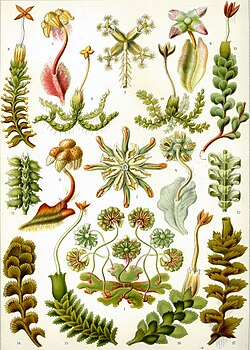
- marchantiophyta
- /ˈlɪvəwɜːt/
- A small flowerless green plant with leaf-like stems or lobed leaves.
Wikitionary definitions:
- A taxonomic phylum within the kingdom Plantae – liverworts, sometimes called a division in Plantae.
- ·
- meiosis
- /maɪˈəʊsɪs/
- A type of cell division that results in four daughter cells each with half the number of chromosomes of the parent cell.
Wikitionary definitions:
- A figure of speech whereby something is made to seem smaller or less important than it actually is.
- Cell division of a diploid cell into four haploid cells, which develop to produce gametes.
- ·

- mitosis
- /maɪˈtəʊsɪs/
- A type of cell division that results in two daughter cells each having the same number and kind of chromosomes as the parent nucleus.
Wikitionary definitions:
- The division of a cell nucleus in which the genome is copied and separated into two identical halves. It is normally followed by cell division.
- ·

- mutualism
- /ˈmjuːtʃuəlɪz(ə)m/
- The way two organisms of different species exist in a relationship in which each individual benefits from the activity of the other.
Wikitionary definitions:
- Any interaction between two species that benefits both; typically involves the exchange of substances or services.
- An economic theory and anarchist school of thought that advocates a society where each person might possess a means of production, either individually or collectively, with trade representing equivalent amounts of labor in the free market.
- ·
- mycelium
- /maɪˈsiːlɪəm/
- The vegetative part of a fungus, consisting of a network of fine white filaments.
Wikitionary definitions:
- The vegetative part of any fungus, consisting of a mass of branching, threadlike hyphae, often underground.
- ·

- mycorrhiza
- /ˌmaɪkəˈraɪzə/
- A symbiotic association between a fungus and the roots of a vascular plant.
Wikitionary definitions:
- A plant root formed in symbiosis with a fungus; the symbiosis between the mycelium of a fungus and the roots of a plant.
- ·
- nucleus
- /ˈnjuːklɪəs/
- The central and most important part of a cell, containing the genetic material.
Wikitionary definitions:
- The core, central part of something, around which other elements are assembled.
- An initial part or version that will receive additions.
- The massive, positively charged central part of an atom, made up of protons and neutrons.
- A large membrane-enclosed organelle found in eukaryotic cells which contains genetic material.
- A ganglion, cluster of many neuronal bodies where synapsing occurs.
- The central part of a syllable, most commonly a vowel.
- ·
- ootheca
- /ˌəʊəˈθiːkə/
- A type of egg case that is produced by any member of the Blattodea order of insects.
Wikitionary definitions:
- An egg case of any of the orthopteroid insects (such as cockroaches and mantids).
- ·

- organelle
- /ˌɔːrɡəˈnɛl/
- A specialized subunit within a cell that has a specific function.
Wikitionary definitions:
- A specialized structure found inside cells that carries out a specific life process (e.g. ribosomes, vacuoles).
- ·
- parasexuality
- /ˌpærəsɛkʃʊˈælɪti/
- A form of sexual reproduction in fungi that does not involve the development of a zygote.
Wikitionary definitions:
- A phenomenon, involving a complex form of mitosis, whereby two cell nuclei merge without any sexual process and the chromosome count is doubled.
- ·
- parasite
- /ˈpærəsaɪt/
- An organism that lives in or on another organism and benefits by deriving nutrients at the host's expense.
Wikitionary definitions:
- An organism that lives on or in another organism of a different species, deriving benefit from living on or in that other organism, while not contributing towards that other organism sufficiently to cover the cost to that other organism.
- An internal parasite that is an animal or protist.
- A person who lives on other people's efforts or expense and gives little or nothing back.
- A sycophant or hanger-on.
- A climbing plant which is supported by a wall, trellis etc.
- A retainer or companion of an ancient Celtic warrior, who praised him in song or poetry at gatherings; a bard.
- A component of a composite aircraft which is carried aloft and air-launched by a larger carrier aircraft or mother ship to support the primary mission of the carrier; a parasite aircraft.
- An isolated (FSDU) (freestanding display unit )
- ·
- parthenogenesis
- /ˌpɑːθɪnəʊˈdʒɛnɪsɪs/
- A form of asexual reproduction in which an unfertilized egg develops into a new individual.
Wikitionary definitions:
- Referring to various aspects of asexual reproduction: (An instance of) reproduction by the development of a single gamete (an ovum or ovule) without fertilisation by a gamete of the opposite sex; compare monogenesis, metagenesis, and heterogamy. Asexual reproduction in toto; agamogenesis.
- (An instance of) reproduction by the development of a single gamete (an ovum or ovule) without fertilisation by a gamete of the opposite sex; compare monogenesis, metagenesis, and heterogamy.
- Asexual reproduction in toto; agamogenesis.
- figurative uses of the biological senses
- Virgin birth, in reference to the Virgin Mary and Jesus Christ.
- ·

- pathogen
- /ˈpæθədʒən/
- A bacterium, virus, or other microorganism that can cause disease
Wikitionary definitions:
- An agent that can cause disease, especially an infectious microorganism, such as a bacterium, virus, protozoon or fungus.
- ·
- prokaryote
- /prəʊˈkærɪəʊt/
- A microscopic single-celled organism that has neither a distinct nucleus with a membrane nor other specialized organelles.
Wikitionary definitions:
- An organism whose cell (or cells) are characterized by the absence of a nucleus or any other membrane-bound organelles.
- In the two-empire system of biological taxonomy, an organism of the kingdom Prokaryotae (now superseded).
- ·

- saprotroph
- /ˈsæprəʊtrəʊf/
- An organism that feeds on or derives nourishment from decaying organic matter.
Wikitionary definitions:
- An organism that lives off dead or decaying organic material by secreting enzymes into it and then absorbing its nutrients.
- ·
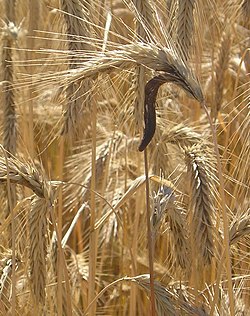
- sclerotium
- /skləˈrəʊʃɪəm/
- A compact mass of hardened fungal mycelium containing food reserves.
Wikitionary definitions:
- A compact mass of hardened mycelium stored with reserve food material that, in some higher fungi such as ergot, becomes detached and remains dormant until a favourable opportunity for growth occurs.
- ·
- septate
- /ˈsɛpteɪt/
- Divided by a septum or septa.
Wikitionary definitions:
- Of, pertaining to, or divided by a septum.
- ·
- septum
- /ˈsɛptəm/
- A partition separating two chambers, such as that between the nostrils or the chambers of the heart.
Wikitionary definitions:
- A wall separating two cavities; a partition.
- Ellipsis of nasal septum: the cartilaginous center wall of the nose separating the two nostrils.
- Either of the two walls that separate the atria or ventricles of the heart into left and right chambers.
- A partition that separates the cells of a fruit.
- A partition that separates the cells of a (septated) fungus.
- One of the radial calcareous plates of a coral.
- One of the transverse partitions dividing the shell of a mollusk, or of a rhizopod, into several chambers.
- One of the transverse partitions dividing the body cavity of an annelid.
- Ellipsis of septum ring or septum piercing.
- ·
- sporangiospore
- /spɔːˈreɪndʒɪəˌspɔː/
- A spore formed within a sporangium.
Wikitionary definitions:
- A spore produced by a sporangium (in many fungi, such as zygomycetes).
- ·
- sporangium
- /spɔːˈreɪndʒɪəm/
- A receptacle in which asexual spores are formed.
Wikitionary definitions:
- A case, capsule, or container in which spores are produced by an organism.
- ·
- syncytium
- /sɪnˈsɪʃɪəm/
- A multinucleate cell resulting from multiple cell fusions.
Wikitionary definitions:
- A mass of cytoplasm containing many nuclei; a multinucleate cell resulting from cell fusions of mononuclear cells (for example, the cells that make up animal Skeletal muscle).
- ·
- zygote
- /ˈzaɪɡəʊt/
- A diploid cell resulting from the fusion of two haploid gametes.
Wikitionary definitions:
- A fertilized egg cell.
- ·