
Wikipedia article
Turkey-tail
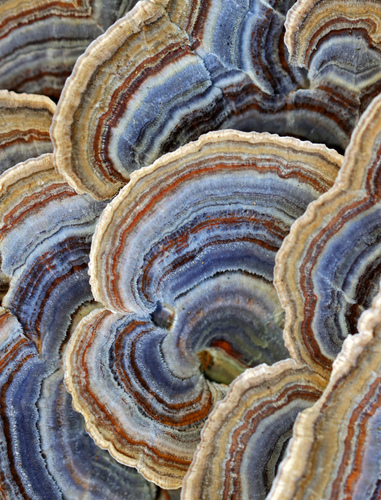
Trametes versicolor – also known as Coriolus versicolor and Polyporus versicolor – is a common polypore mushroom found throughout the world. Owing to its shape being similar to that of a wild turkey's tail feathers, T. versicolor is most commonly referred to as turkey tail. Although polysaccharide-K, an extract of T. versicolor, is approved in Japan as an adjuvant therapy in cancer treatment, it is not approved in the United States for treatment of cancer or any clinical condition. Extracts of turkey tail or the mushroom itself are commonly marketed as a dietary supplement for various health benefits, and quality can vary due to inconsistent processing and labeling.
Etymology
Meaning 'of several colors', versicolor accurately describes this fungus that displays a unique blend of markings.
Description
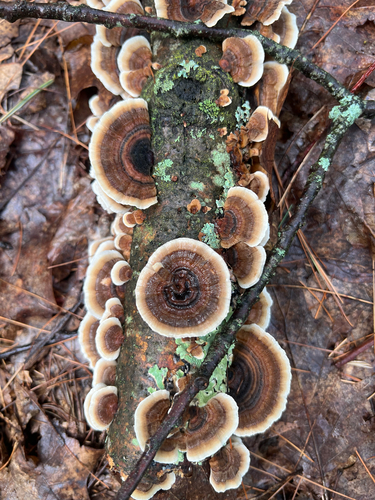
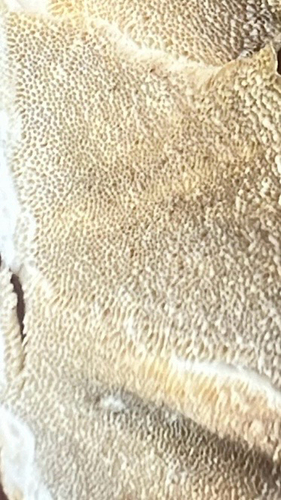
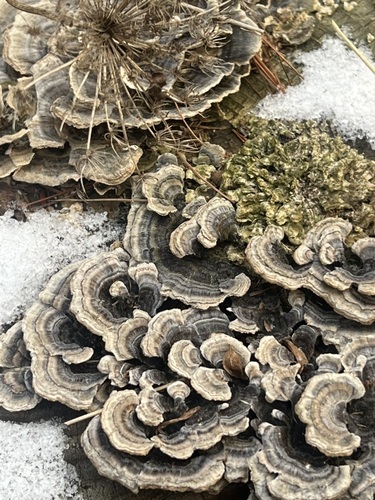
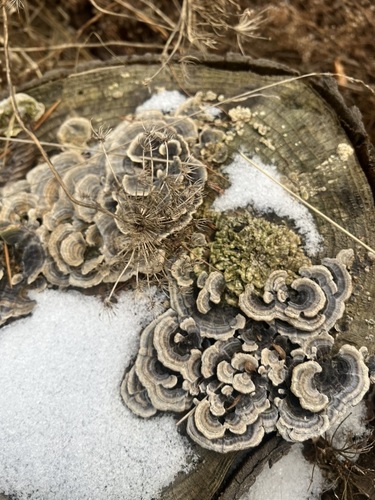
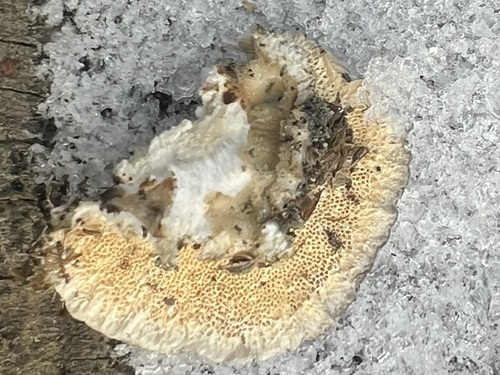
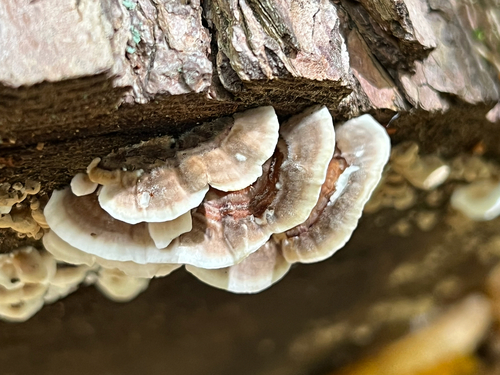
The fruiting body is somewhat tongue-shaped, with no discernable stalk, and the tough flesh is 1–3 millimetres (1⁄16–1⁄8 in) thick. The cap is flat, up to 10 centimetres (4 in) across. It is often triangular or round, with zones of fine hairs coloured rust-brown or darker brown, sometimes with black zones. Underneath a layer of tomentum is a black layer, topping the whitish flesh. Older specimens can have zones with green algae growing on them. The bottom surface of the cap shows typical concentric zones of different colors, with the margin always the lightest. There are 3–5 pores per mm. They are whitish to light brown, with pores round and with age twisted and labyrinthine.
Similar species
One similar-looking mushroom is Stereum ostrea (false turkey tail). Other similar species include Trametes betulina, T. hirsuta, T. ochracea, T. suaveolens, Bjerkandera adusta, Cerrena unicolor, Lenzites betulina, and Stereum hirsutum. Other species of Stereum are similar, typically with a smooth undersurface, as well as some species of Trichaptum.
Ecology
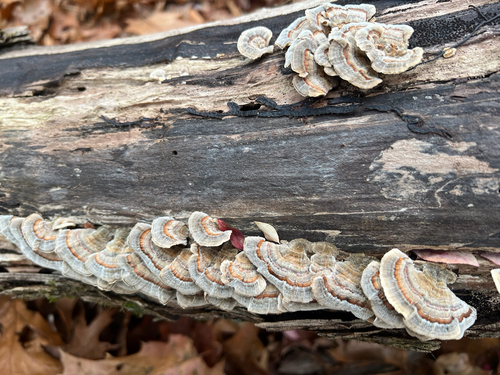
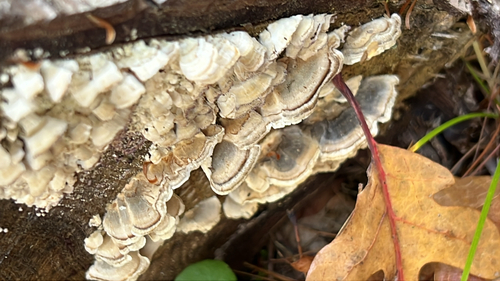
T. versicolor commonly grows in tiled layers in groups or rows on logs and stumps of deciduous trees. It is a white rot fungus which degrades lignin from lignocellulosic materials, such as wood. The species may be eaten by caterpillars of the fungus moth Nemaxera betulinella, maggots of the fly Polyporivora picta, and the fungus gnat Mycetophila luctuosa.
Uses
Trametes versicolor is considered too tough to eat, but can be prepared in many ways, such as teas and powders. It has been most notably consumed in China for thousands of years under the name "Yunzhi" (Chinese: 云芝). The species may be used in traditional Chinese medicine or other herbalism practices. Although polysaccharide-K is approved in Japan as an adjuvant therapy in cancer treatment, neither the extract nor the mushroom preparation is approved or used in the United States for any clinical condition. It is commonly marketed as a dietary supplement for various health benefits, but lacks sufficient scientific evidence for safety or effectiveness, and quality can vary due to inconsistent processing and labeling.
Gallery
See also
List of Trametes species Polysaccharide peptide Medicinal fungi
References
External links
Trametes versicolor at Mushroom-Collecting.com
Observations
Amherst, MA, US · research grade
State St, Amherst, MA, US · research grade
Wendell Rd, Shutesbury, MA, US ·
Massachusetts, US · research grade
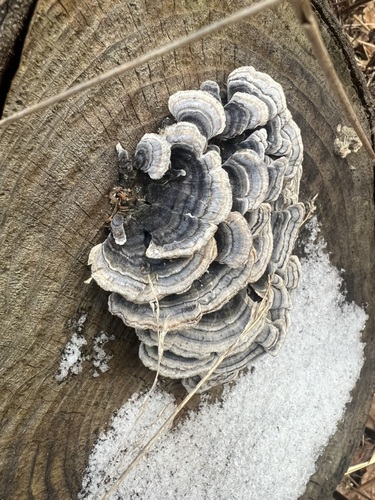
Pelham, MA, USA ·
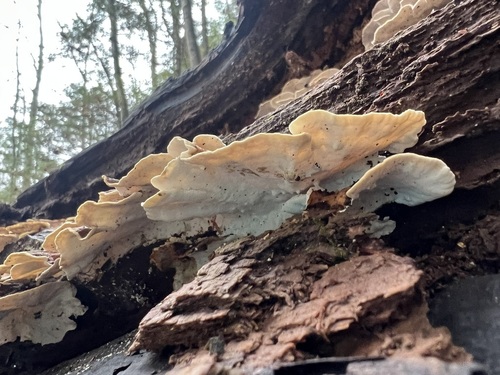
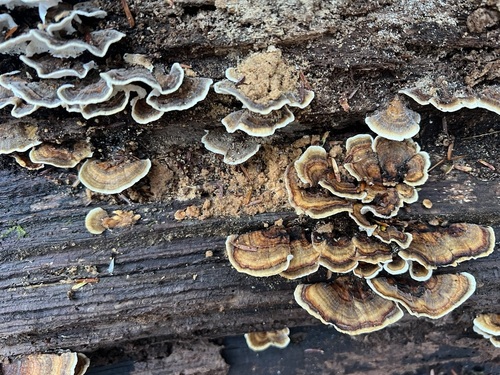
Buffam Falls, Pelham, MA, US · research grade
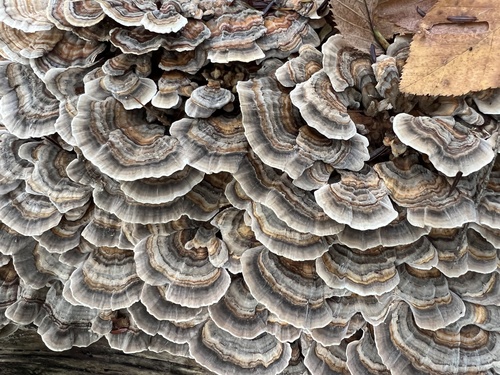
West Whately ·
Features[1]
Ecology Saprobic on the deadwood of hardwoods, or rarely on the wood of conifers; annual; causing a white rot of the sapwood; growing in dense, overlapping clusters or rosettes on logs and stumps; year-round; very widely distributed and common in North America. The illustrated and described collections are from Illinois.
Cap 2–8 cm across; 1–4 cm deep; 1–2 mm thick; plano-convex to flat; in outline circular, semicircular, fan-shaped, bracket-shaped, or kidney-shaped; often fused with other caps; flexible when fresh; densely hairy or velvety, often with alternating zones of texture; with concentric zones of white, gray, brown, cinnamon, orangish, and reddish brown (but highly variable in color and sometimes with other shades, including blue, green, and orange).
Pore Surface Whitish to pale brownish; not bruising; with 3–6 or more tiny pores per mm; tubes up to 1.5 mm deep.
Flesh Insubstantial; whitish, except for a very thin black line (in cross-section) separating the cap surface from the flesh; tough and leathery.
Odor and Taste Not distinctive.
Chemical Reactions KOH negative to yellowish or yellow on flesh.
Spore Print Whitish.
Microscopic Features Spores 4.5–5.5 x 1.5–2 µm; cylindric; smooth; hyaline in KOH; inamyloid. Basidia 18–20 x 3–4.5 µ
Dichotomic identification[1:1]
-
Is the pore surface a real pore surface? Like, can you see actual pores?
Yes: Continue.
No: See Stereum ostrea and other crust fungi. -
Squint real hard. Would you say there are about 1–3 pores per millimeter (which would make them fairly easy to see), or about 3–8 pores per millimeter (which would make them very tiny)?
3–8 per mm: Continue.
1–3 per mm: See several other species of Trametes. -
Is the cap conspicuously fuzzy, velvety, or finely hairy (use a magnifying glass or rub it with your thumb)?
Yes: Continue.
No: See several other species of Trametes. -
Is the fresh cap whitish to grayish?
Yes: See Trametes hirsuta.
No: Continue. -
Does the cap lack starkly contrasting color zones (are the zones merely textural, or do they represent subtle shades of the same color)?
Yes: See Trametes pubescens.
No: Continue. -
Is the fresh mushroom rigid and hard, or thin and flexible?
Rigid and hard: See Trametes ochracea.
Thin and flexible: Totally True Turkey Tail.
Kuo, M. (2017, November). Trametes versicolor. Retrieved from the mushroomexpert.com website. ↩︎ ↩︎